
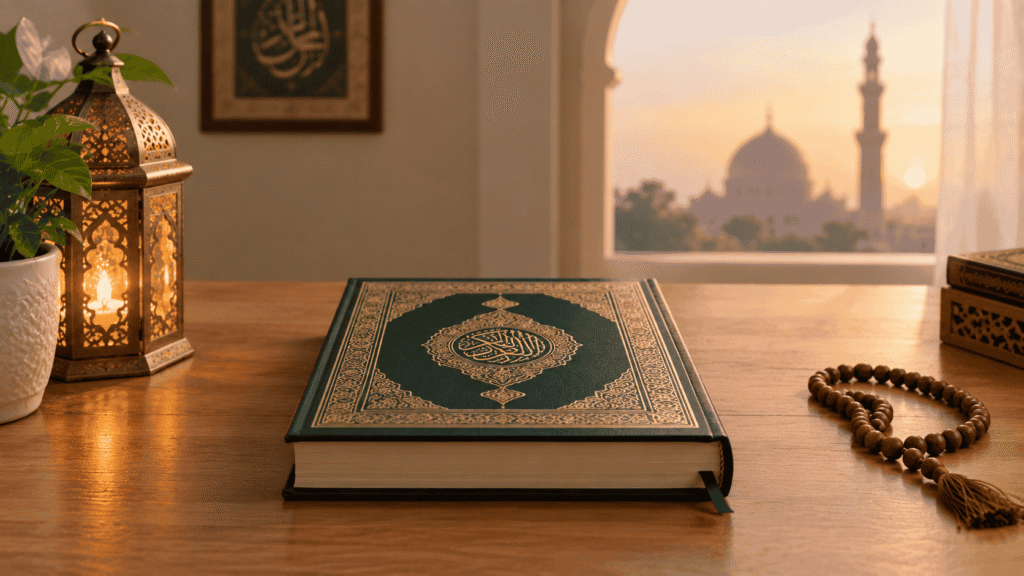
The Quran tells the stories of many prophets, from Adam to Muhammad ﷺ, yet it does not claim to list every prophet Allah ever sent. This surprises some readers, especially those new to the Quran, who expect a complete historical record rather than a book built around guidance and reflection.
The Quran itself answers this question directly. It was never meant to be a chronicle of every messenger in human history. It is meant to guide the heart, and it tells the stories that best serve that purpose.
Why Doesn’t the Quran Mention All the Prophets?
Allah addresses this exact question in the Quran. In Surah Ghafir, He says:
“And We have already sent messengers before you. Among them are those [whose stories] We have related to you, and among them are those [whose stories] We have not related to you.” (Surah Ghafir, 40:78)
A very similar statement appears in Surah An-Nisa (4:164). Both verses make the same point clearly: Allah sent messengers whose stories are told in the Quran, and others whose stories are not. This is not an oversight. It is stated as a deliberate fact about how the Quran was revealed.
How Many Prophets Does the Quran Name?
The Quran names 25 individuals as prophets or messengers: Adam, Idris (Enoch), Nuh (Noah), Hud, Salih, Ibrahim (Abraham), Lut (Lot), Ismail (Ishmael), Ishaq (Isaac), Yaqub (Jacob), Yusuf (Joseph), Shu’aib (Jethro), Musa (Moses), Harun (Aaron), Dawud (David), Sulayman (Solomon), Ayyub (Job), Dhul-Kifl, Ilyas (Elijah), Alyasa (Elisha), Yunus (Jonah), Zakariya (Zechariah), Yahya (John the Baptist), Isa (Jesus), and Muhammad ﷺ. Their stories are woven throughout the Quran, often repeated in different surahs to highlight different lessons.
This number is not stated as a complete count in the Quran itself. It simply reflects how many prophets are named across the text. Beyond this, the Quran does not commit to an exact total.
What About the Hadith That Mentions 124,000 Prophets?
Many Muslims have heard that Allah sent 124,000 prophets throughout history. This figure comes from a hadith found in collections like Musnad Ahmad, not from the Quran. It is important to know that the chains of narration for this hadith are classified as weak (da’if) by the majority of hadith scholars, due to unreliable narrators in its chain.
This does not mean the general idea is wrong. It is entirely reasonable, based on 40:78, to believe Allah sent many more prophets than the Quran names. But the specific number 124,000 should be held loosely, as a commonly repeated tradition rather than a firmly established fact from an authentic hadith or the Quran itself.
Why Are Some Prophets’ Stories Told and Others Left Out?
The Quran was not revealed as a history textbook. It was revealed to guide people toward Allah, correct their beliefs, and teach moral and spiritual lessons through real examples. The prophets whose stories appear most often, such as Musa, Ibrahim, and Yusuf, are the ones whose experiences carried lessons that were especially relevant to the people first receiving the Quran, and that remain relevant to every generation after them.
This same principle is echoed in the closing verse of Surah Yusuf. It’s worth being precise here: this verse is speaking specifically about the story just told, that of Yusuf, his brothers, and his family, not making a general statement about prophets as a category:
“There was certainly in their stories a lesson for those of understanding.” (Surah Yusuf, 12:111)
Even read narrowly, in reference to Yusuf’s own story, this verse reflects the same reasoning found in 40:78: the Quran includes what carries a lesson “for those of understanding,” rather than aiming to be a complete historical record. Many scholars extend this same reasoning to explain the Quran’s broader approach to prophetic accounts in general, though the verse itself is not making that claim directly.
Does Leaving Out a Prophet Make Them Less Important?
No. This is one of the clearest points in 40:78 — the prophets whose stories are not told are mentioned in the very same breath as those whose stories are told, with no suggestion that one group matters more than the other. Muslims are required to believe in all of Allah’s prophets and messengers as a matter of faith, whether or not the Quran narrates their individual stories. If you’re building this foundational belief for the first time, it helps to pair it with the basics of what a Muslim should prioritize learning early on, which we cover in What Should a Muslim Learn First?
What This Teaches Us About the Quran’s Purpose
Understanding why the Quran leaves some prophets unnamed helps clarify what kind of book the Quran actually is. It is not attempting to be exhaustive. It is intentional, addressing exactly what is needed for guidance, warning, and reflection.
This same intentional pattern appears elsewhere in the Quran, including in how it repeatedly addresses all of humanity directly. For example, the phrase “O Children of Adam” appears several times in Surah Al-A’raf, which we explore in more depth in Why Does the Quran Say “O Children of Adam”?
Reading the Quran’s prophetic stories with this purpose in mind can also make your recitation more meaningful. If you are still building comfort with reading the Arabic text itself, our guide on Quran Pronunciation is a good next step, and structured lessons through Learn Quran Online can help you study these stories with proper guidance rather than piecing them together alone.
Frequently Asked Questions
The Quran explicitly states in 40:78 and 4:164 that some prophets’ stories were told and others were not. The Quran is a book of guidance, not a complete historical record, so it includes the stories most relevant to its lessons.
The Quran names all 25 of them: Adam, Idris, Nuh, Hud, Salih, Ibrahim, Lut, Ismail, Ishaq, Yaqub, Yusuf, Shu’aib, Musa, Harun, Dawud, Sulayman, Ayyub, Dhul-Kifl, Ilyas, Alyasa, Yunus, Zakariya, Yahya, Isa, and Muhammad. This is not stated as a complete total.
This figure comes from a hadith in collections like Musnad Ahmad that most hadith scholars classify as weak (da’if). It is a widely repeated tradition, not a confirmed number from the Quran or an authentic hadith.
Yes. Belief in all of Allah’s prophets and messengers, named or unnamed, is part of Islamic faith, as indicated in 40:78.
Final Thoughts
The Quran does not name every prophet because it was never meant to be a complete historical record. It tells the stories that carry the lessons people need, generation after generation, while still affirming that Allah sent many more messengers whose stories were not related. Recognizing this helps readers approach the Quran the way it was meant to be read: not as an encyclopedia of names, but as guidance meant to be reflected upon.
Pingback: Why Does the Quran Say “O Children of Adam”? - Study Quran Now